SCB13 Dry-Type Transformer Selection Guide for International Projects
Start with project duty, not the SCB13 model name
SCB13 is a Chinese model-family designation for cast-resin dry-type transformers. It does not by itself guarantee a voltage ratio, capacity, loss level, impedance, vector group, enclosure, climate class, fire behaviour class, or destination-country approval. The purchase specification and approved manufacturer data must define the supplied unit.
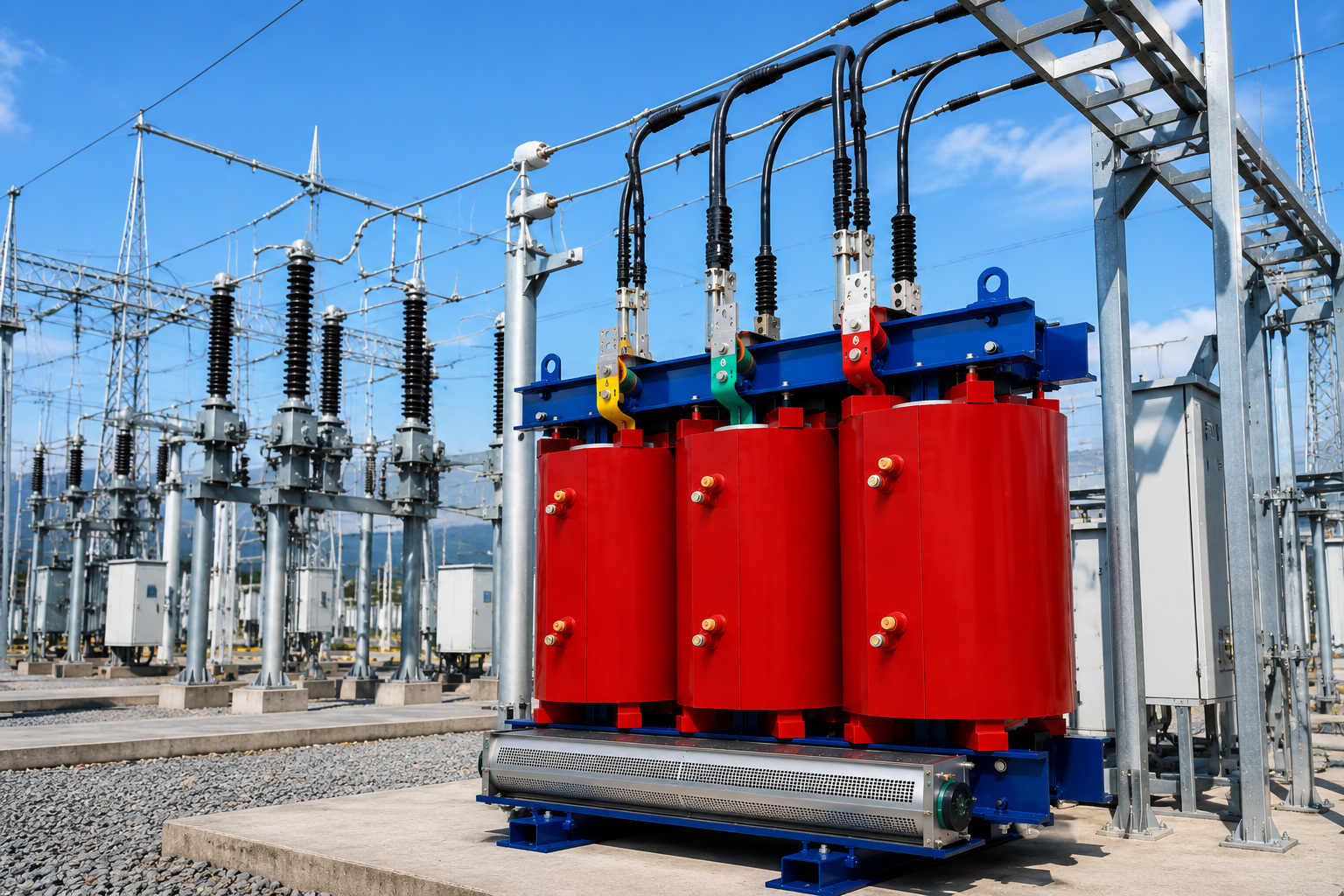
SCB13 RFQ checklist
| Required input | Procurement decision |
|---|---|
| Rated power and load profile | Confirm continuous duty, overload expectation and growth margin. |
| Primary and secondary voltage | Confirm utility or system voltage, tapping and insulation level. |
| Frequency, phases and vector group | Coordinate the transformer with the network and downstream protection. |
| Guaranteed no-load and load losses | Compare compliant offers using the same reference temperature and tender basis. |
| Impedance | Coordinate voltage regulation, fault current and parallel operation. |
| Installation environment | State altitude, ambient temperature, humidity, pollution, seismic duty and indoor room conditions. |
| Cooling and enclosure | Define AN/AF duty, fan controls, enclosure degree and ventilation interface. |
| Terminations and accessories | Define cable or busbar connection, sensors, controller, alarms and communications. |
| Standards and tests | Define routine, type and special tests plus the required reports and witness points. |
IEC framework
IEC 60076-11:2018 applies to dry-type power transformers within its stated scope and addresses matters including enclosure management, altitude effects, environmental classes, fire behaviour classes and seismic class. IEC 60076-1:2011 provides general power-transformer requirements. The applicable editions and project deviations should be named in the RFQ.
How to compare quotations
- Normalize every offer to the same rating, voltages, frequency, impedance, vector group and reference temperature.
- Compare guaranteed loss tables, not marketing labels such as high efficiency.
- Check that enclosure and forced-air options do not invalidate the quoted AN rating or environmental class.
- Confirm which tests are included, witnessed, repeated, or supported by existing evidence.
- Review dimensions, mass, termination position, room ventilation and handling route before approval.
Evidence boundary
This guide does not claim a universal SCB13 loss table, certification, efficiency class, or local approval. ZY POWER can prepare a project-specific offer and documentation plan after receiving the electrical duty and destination requirements.
Product and datasheet
FAQ
Is SCB13 an IEC efficiency class?
No. Treat SCB13 as a model-family designation. Specify and compare guaranteed losses against the project requirement and applicable standard.
Can SCB13 operate at 50 Hz or 60 Hz?
The required frequency must be stated in the RFQ and confirmed in the approved datasheet and nameplate. Do not infer it from the model code.
What information is needed for a quotation?
Provide capacity, voltages, frequency, vector group, impedance, loss requirement, installation conditions, enclosure, accessories, tests, quantity and destination.
Download This Guide as PDF
Save this technical guide for offline reference. Includes all tables, specifications, and contact information.
Related Articles
SCB13 Dry-Type Transformer Installation and Pre-Energization Guide
A project-safe installation workflow for receiving, siting, ventilation, earthing, terminations, sensors, inspection, and pre-energization records.
SCB13 Dry-Type Transformer Maintenance and Inspection Guide
A condition-based SCB13 maintenance framework for safe inspection, cleaning, thermal review, connections, sensors, fans, records, and escalation.
SCB13 vs SCB14 Dry-Type Transformer Comparison for EPC Procurement
Compare SCB13 and SCB14 offers using guaranteed losses, duty, impedance, dimensions, tests, documentation, and lifecycle cost instead of relying on the model number.