Ziyao Power
Home
ProjectsResourcesAboutContact

Industrial Power Distribution Guide

Transformers, switchgear, standards & best practices for reliable industrial power systems

Industrial Power Distribution Architecture

A well-designed industrial power distribution system ensures reliable power delivery from the utility connection point to every load. The typical architecture follows a hierarchical structure with clear voltage levels and protection zones.

HV Incoming

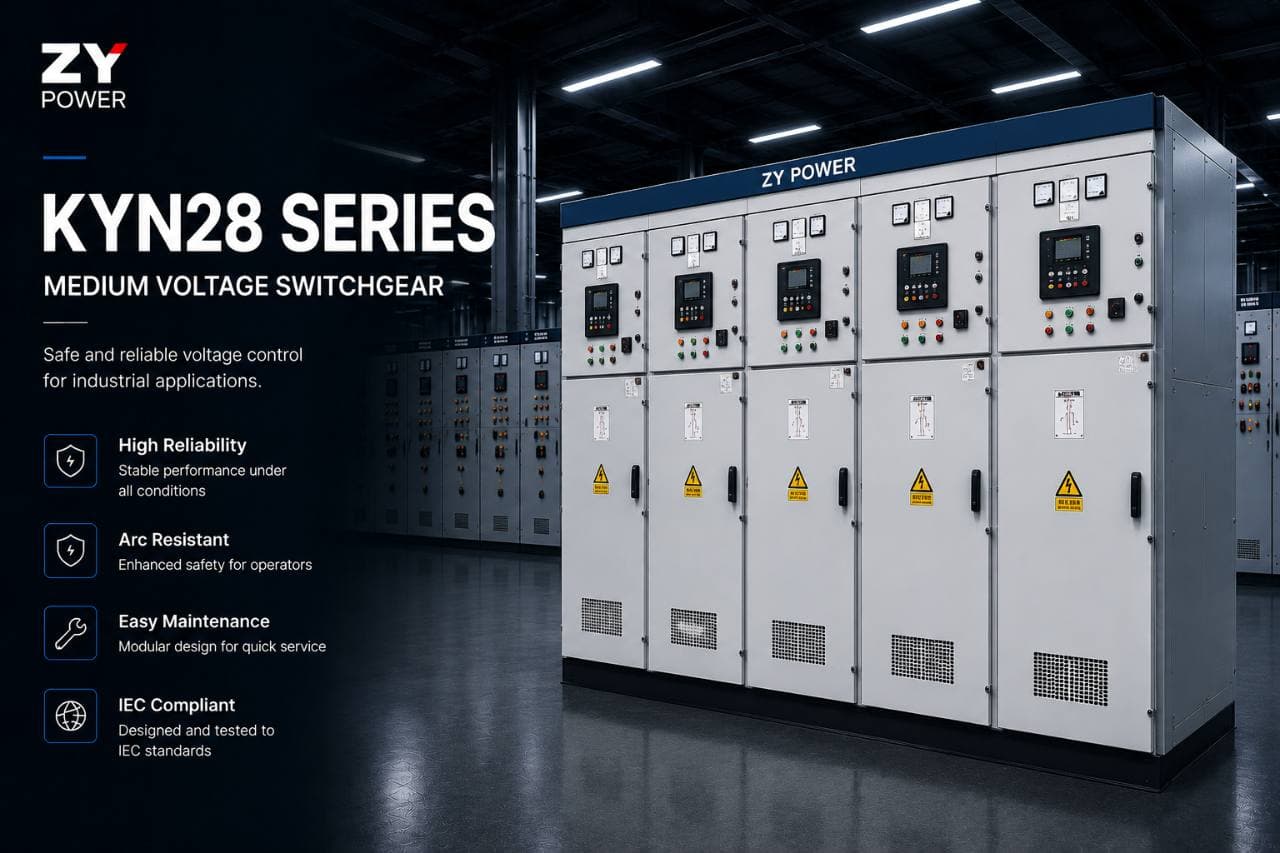
High-Voltage Switchgear (10kV / 35kV)

Utility supply enters via HV switchgear with protection relays, metering, and isolation. Vacuum or SF6 circuit breakers provide fault interruption.

Transformer

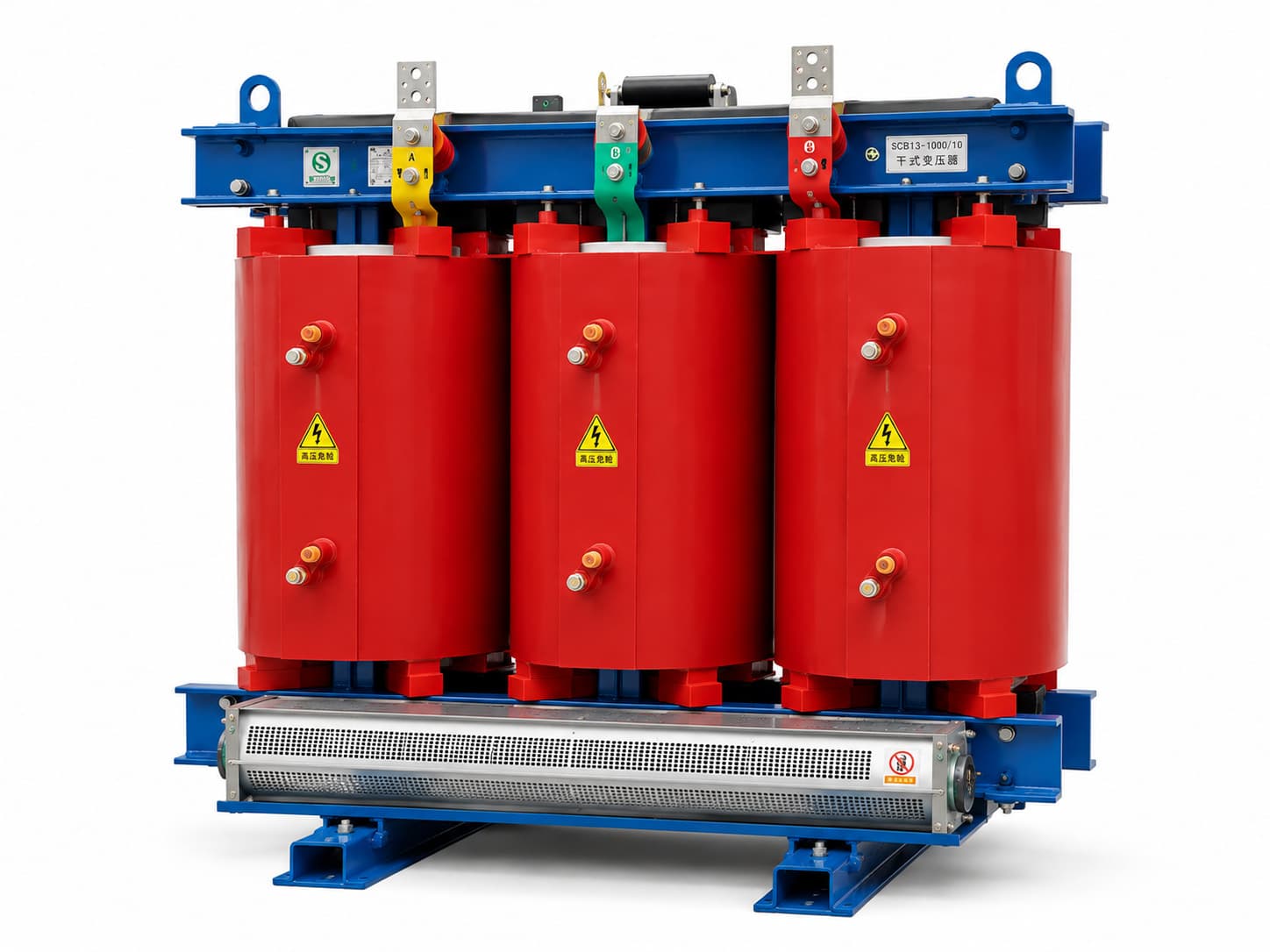
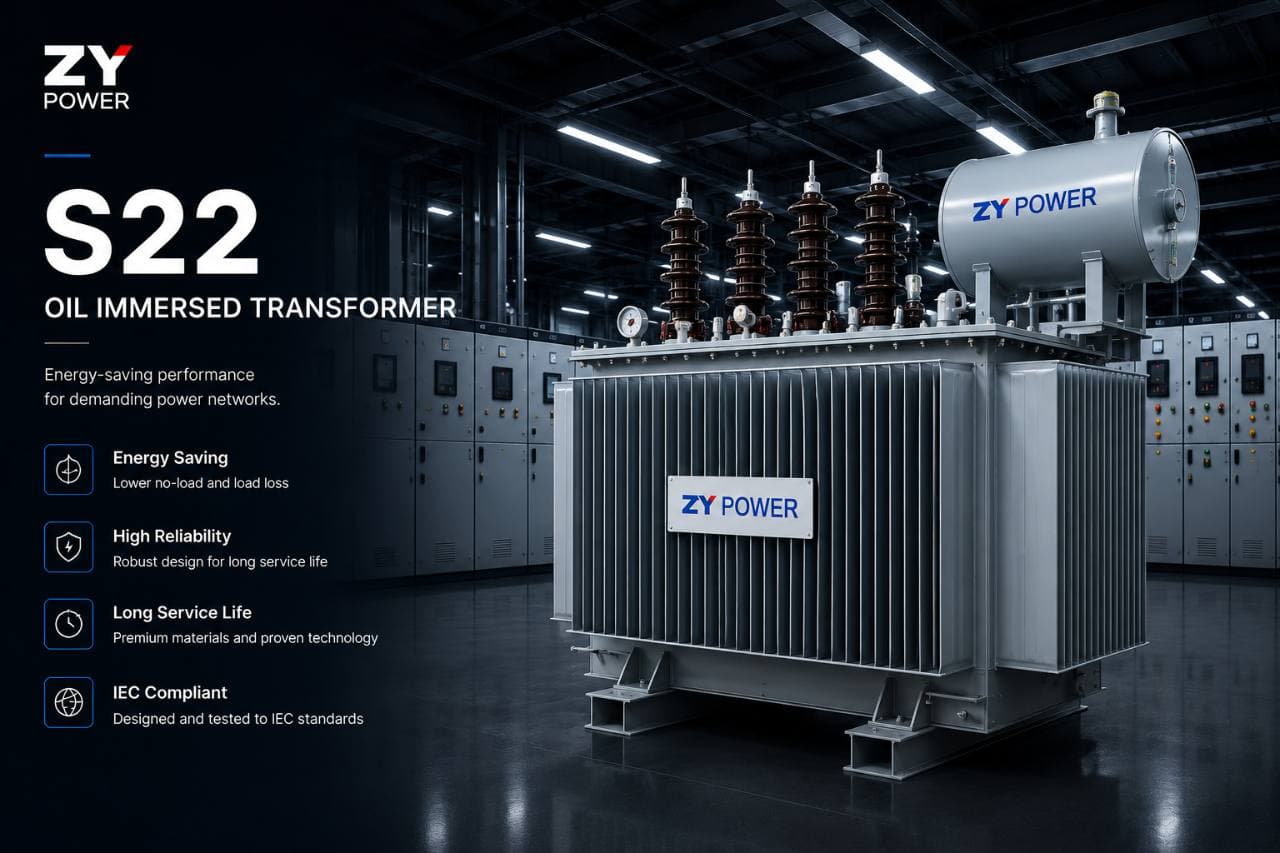
Power Transformer

Steps voltage from HV (10kV/35kV) to LV (380V/400V/415V). Selection depends on load type, installation environment, and efficiency requirements.

Main ACB

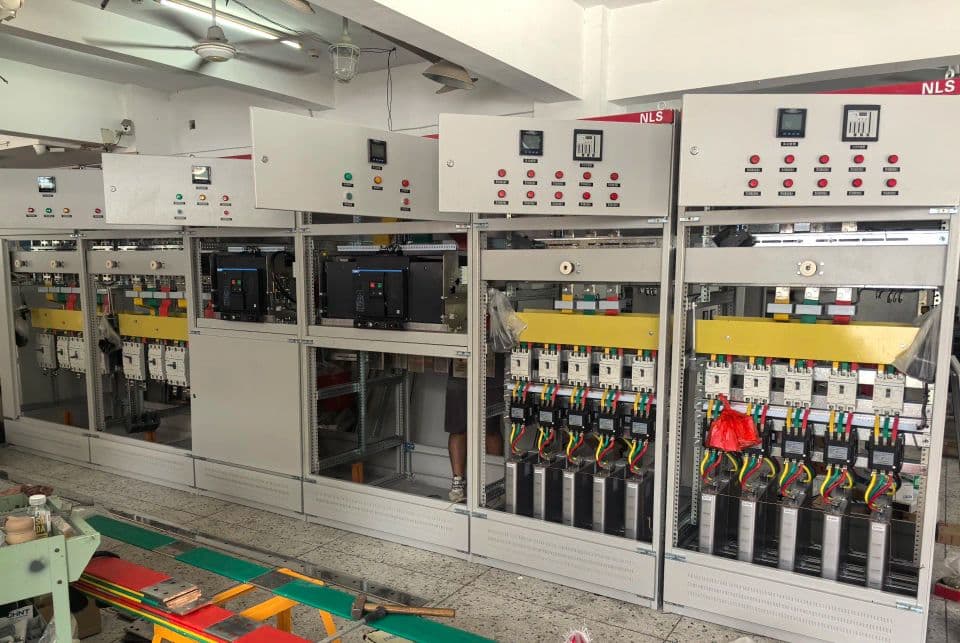
Main Low-Voltage Distribution Board

Central distribution with main air circuit breaker (DW45/DW50), busbar system, and feeder breakers distributing power to sub-panels and motor control centers.

Sub-Distribution

Sub-Distribution & Motor Control Centers

MCCBs (CM1, NM1 series) protect feeder circuits. Motor control centers manage motor starting, protection, and control for production equipment.

Power Quality

Reactive Power Compensation

Capacitor banks and harmonic filters improve power factor, reduce losses, and meet utility power factor requirements (typically ≥0.95).

Single-Line Diagram Tip: Always prepare a detailed SLD before equipment selection. It defines protection zones, fault levels, and coordination requirements.

Transformer Selection

Choosing the right transformer is critical for system reliability and operating costs. Key factors include load type, installation environment, efficiency requirements, and applicable standards.

ParameterDry-Type (SCB Series)Oil-Immersed (S Series)
InsulationEpoxy resin cast (Class F/H)Mineral oil / silicone oil
CoolingAN / AF (air)ONAN / ONAF (oil)
Fire SafetySelf-extinguishing, fire-resistantOil fire risk, requires oil containment
InstallationIndoor / near load centersOutdoor substation / indoor with bund
Capacity Range30 – 2500 kVA100 kVA to utility-scale ratings
Efficiency96.5% – 98.5%97.5% – 99.5%
MaintenanceLow (annual inspection)Medium (oil testing every 2–3 years)
StandardIEC 60076-11IEC 60076-1

⚡ Best For Dry-Type

  • • Indoor substations in buildings
  • • Fire-sensitive environments
  • • Hospitals, data centers, malls
  • • Locations near occupied spaces
  • • SCB18 for ultra-low loss

🏭 Best For Oil-Immersed

  • • Outdoor substations
  • • Heavy industrial plants
  • • High power ratings (>2500 kVA)
  • • Utility distribution networks
  • • Cost-sensitive projects
Dry-Type Transformer Guide →View SCB18 Series →

Switchgear & MCCB Selection

Circuit breakers are the backbone of power distribution protection. Proper selection ensures fault clearance within safe limits while coordinating with upstream and downstream devices.

ModelTypeRatingBreaking CapacityApplication
DW45ACB (Air Circuit Breaker)630A – 6300A42kA – 120kAMain incomer, feeder protection
DW50ACB (Air Circuit Breaker)630A – 6300A50kA – 150kAMain incomer, high-fault-level sites
CM1MCCB (Moulded Case)63A – 800A25kA – 100kASub-distribution, motor protection
NM1MCCB (Moulded Case)63A – 630A25kA – 85kAFeeder circuits, lighting panels

Selection Criteria

  • • Rated current: Must exceed maximum expected load current
  • • Breaking capacity: Must exceed calculated fault level at installation point
  • • Discrimination: Ensure proper time-current coordination between upstream and downstream breakers
  • • Trip unit: Select LSIG (Long-Short-Instant-Ground) protection for industrial loads

Technical Parameters

Key technical parameters for common industrial power distribution equipment.

Dry-Type Transformer Parameters (SCB18 Series)

Rating (kVA)No-Load Loss (W)Load Loss 75°C (W)No-Load Current (%)Impedance (%)
1001801,5800.804.0
2003002,6600.704.0
4004704,4600.604.0
6306406,3200.506.0
10009208,8800.506.0
16001,26012,2500.406.0
25001,80016,8000.406.0

DW50 ACB Trip Unit Settings (Typical)

Protection FunctionSetting RangeTime DelayPurpose
Long-time (L)0.4 – 1.0 × In4 – 120sOverload protection
Short-time (S)1.5 – 10 × In0.1 – 0.4sShort-circuit discrimination
Instantaneous (I)1.5 – 15 × In<50msHigh-fault clearance
Ground fault (G)0.2 – 1.0 × In0.1 – 0.8sEarth fault protection

IEC Standards for Industrial Power Distribution

International Electrotechnical Commission (IEC) standards define design, testing, and performance requirements for industrial power equipment. Compliance ensures safety, interoperability, and reliability.

StandardScopeKey Requirements
IEC 61439Low-voltage switchgear assembliesType testing (TTA), routine verification, temperature rise limits, short-circuit withstand, protection against electric shock
IEC 62271High-voltage switchgear & controlgearSwitching capability, insulation coordination, partial discharge limits, seismic withstand, indoor/outdoor ratings
IEC 60076-1Power transformers (general)Rating, temperature rise, insulation levels, no-load and load losses, short-circuit impedance
IEC 60076-11Dry-type transformersCast resin and non-encapsulated winding requirements, thermal class, environmental conditions
IEC 60364Low-voltage electrical installationsEarthing arrangements, cable sizing, protection against overcurrent, surge protection
IEC 60947Low-voltage switchgear & controlgearCircuit breaker requirements, contactors, motor starters, coordination with fuses
IEC 60282High-voltage fusesCurrent-limiting fuse performance, fuse-switch combinations, back-up protection coordination

IEC vs ANSI Standards Comparison

Understanding the differences between IEC and ANSI standards is essential for multinational projects or when sourcing equipment from different markets.

AspectIECANSI/IEEE
Voltage Ratings (MV)12kV, 24kV, 40.5kV4.16kV, 13.8kV, 38kV
Short-Circuit CurrentSymmetrical RMSAsymmetrical (X/R factor)
Frequency50Hz (primary)60Hz (primary)
Insulation CoordinationBIL per IEC 60071BIL per IEEE C37
Switchgear TestingType test + routine (IEC 62271)Design test + production (IEEE C37)
Transformer EfficiencyIEC 60076-20 (Tier 1/2)DOE / NEMA TP-1
GroundingTN-S, TN-C-S (IEC 60364)Solidly grounded (NEC)
Cable SizingIEC 60364-5-52NEC Table 310.16

Practical Note: When importing ANSI-rated equipment into IEC markets, verify voltage compatibility, derate appropriately, and ensure protection coordination meets local standards.

Installation in Industrial Environments

Industrial environments present unique challenges: dust, humidity, vibration, and chemical exposure. Proper installation ensures equipment longevity and reliable operation.

🏗️ Electrical Room Requirements

  • • Minimum IP rating: IP31 for dry areas, IP54 for dusty environments
  • • Fire suppression: CO₂ or clean agent (no water near switchgear)
  • • Ventilation: 15–20 air changes per hour for heat dissipation
  • • Lighting: Minimum 300 lux at panel face for maintenance
  • • Access: Minimum 1.2m clear space in front of panels

⚠️ Environmental Considerations

  • • Ambient temperature: -5°C to +40°C (standard), up to +50°C derated
  • • Relative humidity: Below 95% (non-condensing)
  • • Altitude: Above 1000m requires derating per IEC 61439
  • • Vibration: Isolate from heavy machinery vibrations
  • • Corrosive gases: Use sealed enclosures or anti-corrosion treatment
1.

Cable Routing

Separate power and control cables by at least 200mm. Use cable trays with proper support spacing. Ensure bend radii comply with cable manufacturer specifications.

2.

Busbar Installation

Support busbars at maximum 1m intervals for horizontal runs. Use insulated busbar covers. Apply anti-oxidation compound at bolted joints.

3.

Grounding System

Install main earth bar with multiple ground connections. Equipotential bonding of all metallic enclosures. Ground resistance <1Ω for transformer neutrals.

4.

Commissioning Tests

Perform insulation resistance test (≥1MΩ/kV), contact resistance test, protection relay calibration, and load test before energizing.

Maintenance for Continuous Production

Planned maintenance is essential for minimizing downtime in industrial facilities operating 24/7. A structured maintenance program extends equipment life and prevents costly unplanned outages.

Maintenance TaskFrequencyEquipmentNotes
Visual inspectionMonthlyAll panelsCheck for signs of overheating, dust, moisture
Thermographic scanQuarterlyBusbars, connectionsIdentify hot spots before failure
Insulation resistanceAnnuallyCables, transformerMegger test, record trend data
Contact resistanceAnnuallyACB, MCCB contactsMicro-ohmmeter, compare to baseline
Breaker operation testAnnuallyACB, MCCBOpen/close cycle, check mechanism
Relay calibrationEvery 2 yearsProtection relaysVerify trip settings and timing
Oil analysisEvery 2–3 yearsOil-immersed transformerDGA, moisture content, breakdown voltage

Pro Tip: Implement a computerized maintenance management system (CMMS) to track maintenance schedules, record test data, and trigger work orders automatically.

Power Quality & Loss Calculation

Power quality directly impacts production efficiency and equipment lifespan. Understanding and managing losses helps reduce operating costs significantly.

📊 Transformer Loss Calculation

No-load loss (P₀): Constant, occurs whenever energized. Dominates at low loading.

Load loss (Pₖ): Proportional to load². Dominates at high loading.

Total Loss = P₀ + Pₖ × (S/Sᵣ)²

S = actual load, Sᵣ = rated capacity

Example: SCB18-1000kVA at 80% load
Total Loss = 920 + 8880 × 0.64 = 6,603W

⚡ Power Factor Correction

Target PF: ≥ 0.95 (utility requirement)

Capacitor sizing:

Qc = P × (tan φ₁ - tan φ₂)

P = active power (kW)

φ₁ = current angle, φ₂ = target angle

Example: 500kW load, PF 0.75 → 0.95
Qc = 500 × (0.882 - 0.329) = 277 kVAr

🔔 Common Power Quality Issues

IssueCauseImpactSolution
HarmonicsVFDs, rectifiers, LED driversTransformer overheating, neutral overloadActive/passive harmonic filters
Voltage sagMotor starting, fault clearingEquipment shutdown, PLC resetDedicated feeder, UPS, soft starter
UnbalanceUneven single-phase loadsMotor overheating, increased lossesRedistribute loads, phase balancer

Cooling & Environmental Considerations

Proper thermal management extends equipment life and prevents derating. Environmental conditions directly affect cooling system design and equipment selection.

🌬️ Air Cooling (AN/AF)

  • • AN: Air Natural — convection only, for ratings up to 2500kVA
  • • AF: Air Forced — fans for higher capacity or overload conditions
  • • Ensure unobstructed airflow around transformer
  • • Clean air filters regularly in dusty environments

🛢️ Oil Cooling (ONAN/ONAF)

  • • ONAN: Oil Natural Air Natural — convection only
  • • ONAF: Oil Natural Air Forced — radiator fans
  • • Oil acts as both coolant and insulation
  • • Monitor oil temperature and level continuously

🌡️ Environmental Factors

  • • Altitude derating: 1% per 100m above 1000m
  • • High ambient: Derate transformer by 1.5% per °C above 40°C
  • • Humidity: Dehumidifiers for coastal/damp environments
  • • Dust: IP54+ enclosures, regular cleaning schedule

Temperature Monitoring Best Practices

  • • Install RTD sensors on transformer windings (hot-spot monitoring)
  • • Set alarm at 90% of maximum temperature rise
  • • Use thermal imaging cameras for switchgear connections monthly
  • • Log temperatures to detect degradation trends over time

Frequently Asked Questions

Q: What are the main components of an industrial power distribution system?

The main components include: high-voltage switchgear (incoming and outgoing), power transformers (dry-type or oil-immersed), low-voltage distribution boards with ACBs and MCCBs, motor control centers (MCCs), capacitor banks for power factor correction, and monitoring/protection relays.

Q: When should I choose dry-type vs oil-immersed transformers?

Choose dry-type transformers for indoor installations where fire safety is critical (hospitals, data centers, commercial buildings). Oil-immersed transformers are preferred for outdoor substations, heavy industrial loads, and applications requiring higher efficiency or higher power ratings above 2500 kVA.

Q: What is the difference between DW45 and DW50 air circuit breakers?

DW45 is a mature ACB platform with breaking capacities of 42kA–120kA, widely used in general industrial applications. DW50 is the next-generation platform with intelligent protection, higher breaking capacity (up to 150kA), better communication interfaces, and enhanced arc-extinguishing technology.

Q: How do I size a transformer for industrial loads?

Calculate total connected load, apply demand factors (typically 0.7–0.9 for industrial), add 20–30% future expansion margin, and account for motor starting inrush. For continuous production, choose a transformer loaded to 70–80% of rated capacity for optimal efficiency and lifespan.

Q: What IEC standards govern industrial switchgear?

IEC 61439 covers low-voltage switchgear and controlgear assemblies (type-tested and partially type-tested). IEC 62271 covers high-voltage switchgear and controlgear. IEC 60364 addresses electrical installations in buildings. IEC 60076 covers transformer requirements.

Q: What is the typical voltage level for industrial power distribution?

Most industrial facilities receive power at 10kV or 35kV from the utility, step it down to 380V/400V/415V for distribution. Large motors (above 200kW) may use medium voltage (3.3kV, 6.6kV, or 11kV) directly from step-down transformers.

Q: How often should industrial switchgear be maintained?

Visual inspection monthly, detailed inspection quarterly, comprehensive maintenance annually. This includes checking contacts, measuring insulation resistance, verifying protection settings, cleaning busbars, testing circuit breakers, and thermographic scanning of connections.

Q: What are the key differences between IEC and ANSI standards for switchgear?

Key differences include voltage ratings (IEC: 12kV, 24kV, 40.5kV vs ANSI: 4.16kV, 15kV, 38kV), short-circuit current representation (IEC: symmetrical vs ANSI: asymmetrical X/R ratio), testing procedures, and insulation coordination approaches. IEC is more widely adopted internationally.

Q: How can I reduce power losses in industrial distribution systems?

Use high-efficiency transformers (SCB18 or S18 series), optimize cable sizing to reduce I²R losses, install capacitor banks for power factor correction, balance loads across phases, and consider harmonic filters for non-linear loads. Energy-efficient transformers can save 15–30% in no-load losses.

Case Study: Manufacturing Plant Power Distribution

A large automotive parts manufacturer in East China needed a complete power distribution upgrade to support a new production line, increasing total load from 3MW to 6MW.

📋 Project Requirements

  • • Supply voltage: 35kV utility connection
  • • Total load: 6MW + 25% future margin
  • • Continuous operation (8760h/year)
  • • Motor loads: Multiple 200kW+ motors with VFDs
  • • Power factor: Maintain ≥0.95

✅ Solution Provided

  • • Transformers: 2 × SCB18-2500kVA dry-type
  • • HV Switchgear: KYN28-12 metal-clad, 40.5kV rated
  • • LV ACBs: DW50-4000A main breakers
  • • MCCBs: CM1-400A feeder protection
  • • PFC: 1200kVAr capacitor bank with detuning reactors

Results

  • • System efficiency improved from 94% to 97.5% (SCB18 transformers)
  • • Annual energy savings: approximately ¥180,000 in reduced losses
  • • Power factor maintained at 0.97 with automated PFC system
  • • Zero unplanned outages in the first 12 months of operation
  • • Full IEC 61439 and IEC 62271 compliance achieved

Related Products

Dry-Type Transformers

SCB18, SCB14, SCB13 series. 30–2500kVA. Ultra-low loss, fire-safe, indoor installation.

View SCB18 Series →

Oil-Immersed Transformers

S11, S13, S18 series. 100–100,000kVA. High efficiency for outdoor substations.

View Transformer Range →

HV Switchgear

KYN28, XGN2 metal-clad switchgear. 12kV–40.5kV ratings with vacuum circuit breakers.

View HV Switchgear →

Air Circuit Breakers

DW45, DW50 series ACBs. 630A–6300A with intelligent LSIG trip units.

View ACB Range →

MCCBs

CM1, NM1 series moulded case breakers. 63A–800A for feeder and motor protection.

View MCCB Range →

Power Factor Correction

Capacitor banks, harmonic filters, and automatic PFC panels for industrial applications.

View PFC Products →

Related Knowledge

Deepen your understanding with our comprehensive guides on related topics.

🔧

Dry-Type Transformer Guide

Selection, installation & maintenance for SCB18/SCB14/SCB13

🛢️

Oil-Immersed Transformer Guide

S11, S13, S18 series selection and maintenance

⚡

Switchgear Selection Guide

ACB and MCCB selection, coordination, and standards

📊

Power Quality Guide

Harmonics, power factor correction, and loss reduction

Loading related content...

Need Expert Consultation?

Our engineering team can help you design and select the optimal power distribution system for your industrial project.

Contact Our Engineers →View All Products →
Ziyao Power

Powering Future Infrastructure Worldwide

Global energy infrastructure solutions with an industrial-grade brand presence, export-ready systems, and project-led electrical expertise.

WhatsApp RFQ

Start a direct inquiry with our export team.

Quick RFQ

Contact our project managers for fast response.

Products

  • Power Transformers
  • Dry-Type Transformers
  • Oil Transformers
  • Switchgear
  • Substations
  • Circuit Breakers

Explore

  • Solutions
  • About Us
  • Projects
  • Contact

Resources

  • Download Center
  • Product Catalogs
  • Technical Inquiry

Copyright 2026 Ziyao Electric Co., Ltd. All rights reserved.

WhatsAppExport-ready EPCGlobal Delivery